Evolution of Search Part 3: Maximising Visibility on AI Assistants
In part 3 of our evolution of search discussion, we are looking at how the two worlds of AI and SEO are converging, how to test the performance of the optimisations and set out an implementation roadmap, and offer an SEO to AI checklist
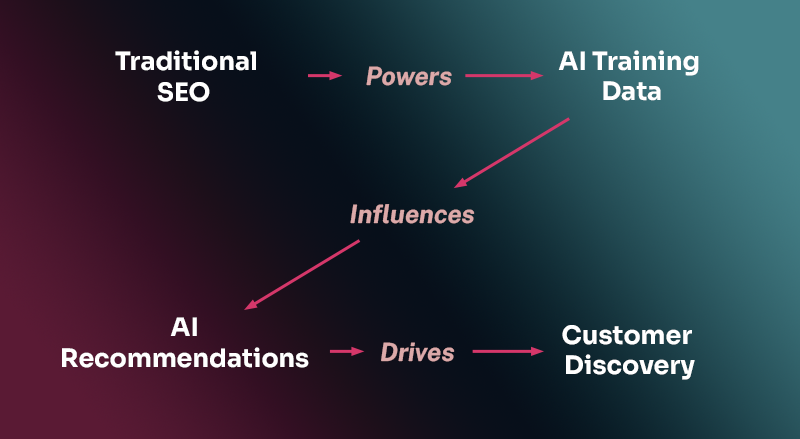
Traditional SEO and AI optimisation aren’t separate disciplines – they’re converging into a unified “Findability” strategy.
Traditional SEO (still essential) ー Powers → AI Training Data ー Influences → AI Recommendations ー Drives → Customer Discovery
Measurement Framework
Traditional SEO Metrics (maintain focus):
Organic traffic
Keyword rankings
Domain authority
Page speed scores
Engagement metrics
Additional AI Visibility Metrics:
AI mention share for category queries
Sentiment in AI responses about brand
Position in AI-generated lists
Accuracy of AI-provided information
Testing Protocol
SEO Testing: Continue traditional rank tracking and technical audits
AI Testing Layer: Add manual or automated* AI query testing to assess how your brand is represented in AI-driven search tools and chat interfaces. When building your query set, aim for a mix of:
Category queries – Broad, non-branded searches that describe your product or service category. Example: “best boutique hotels in [region]”, “top Italian restaurants in [city]” Purpose: See how you surface for general discovery searches.
Intent queries – Searches reflecting a specific goal, occasion, or need. Example: “Valentine’s day restaurants in [region]”, “christmas party venues in [city]” Purpose: Evaluate how well you match searches tied to specific user motivations.
Comparison queries – Side-by-side brand or product comparisons. Example: “[Your brand] vs [competitor]” Purpose: Understand how AI tools present your advantages or disadvantages.
Brand queries – Direct searches for your name or offerings. Example: “Tell me about [brand]”, “What makes
Fanatic IPA
£5.00
unique” Purpose: Check how accurately and compellingly your brand is described.
*We’ll cover tools and methods for automating this process in future articles.
Implementation Roadmap
Phase 1: SEO Foundation Reinforcement
Complete technical SEO audit
Implement comprehensive schema markup
Ensure Google Business Profile optimisation
Audit and align all directory listings
Phase 2: Content Evolution
Develop answer-focused content strategy
Create FAQ pages targeting conversational queries
Optimise existing content for featured snippets
Build topic authority through content clusters
Phase 3: Authority Building
Accelerate digital PR efforts with top-tier publications
Develop review acquisition strategy
Strengthen entity signals across platforms
Build knowledge graph presence
Phase 4: AI-Specific Optimisation
Implement AI-specific content formats
Test and refine based on AI outputs
Develop AI monitoring dashboard
Create feedback loops for continuous improvement
SEO Evolved, Not Replaced
The rise of AI doesn’t invalidate SEO expertise – it extends it. Every principle that made our clients visible in search engines now needs application to AI systems. The competitive advantage lies not in abandoning SEO for something new, but in recognising that AI visibility is SEO’s natural evolution.
Success requires:
Maintaining SEO excellence – it feeds AI systems
Adapting tactics – for how AI interprets signals
Adding new elements – that AI specifically requires
Measuring differently – to track AI performance
This means leveraging existing SEO strengths whilst adding AI-specific optimisations. The brands that win will be those that understand this isn’t a pivot from SEO to AI, but an expansion of SEO to encompass AI.
SEO to AI Checklist
We have created a handy SEO to AI optimisation transition checklist to summarise the key points, please click below to download this.