
June 5, 2026

In a notable shift towards agentic AI becoming a mainstay in our everyday lives, Google recently announced that its AI search tool, AI Mode, can now help users find and book restaurant tables directly through search. The feature, which launched in the UK in April 2026, represents one of the clearest examples yet of AI moving beyond answering questions and into completing tasks on behalf of users.
For restaurants, hotels, bars and event venues, this is more than a new booking feature. It offers a glimpse into the future of search, where AI agents become an active part of the customer journey, influencing not only how consumers discover businesses, but also how they make purchasing decisions.
IBM define Agentic AI as “an artificial intelligence system that can accomplish a specific goal with limited supervision”. Unlike traditional AI tools that simply provide information or answer questions, agentic AI can understand a goal, take action, and complete tasks on a user’s behalf.
In the context of restaurant bookings, a potential restaurant customer no longer needs to perform multiple searches, scroll through reviews, compare booking websites, check availability and navigate through different platforms. Instead, they can simply ask Google AI Mode:
“Find me a dog-friendly Italian restaurant in Somerset for four people this Saturday at 7pm.”
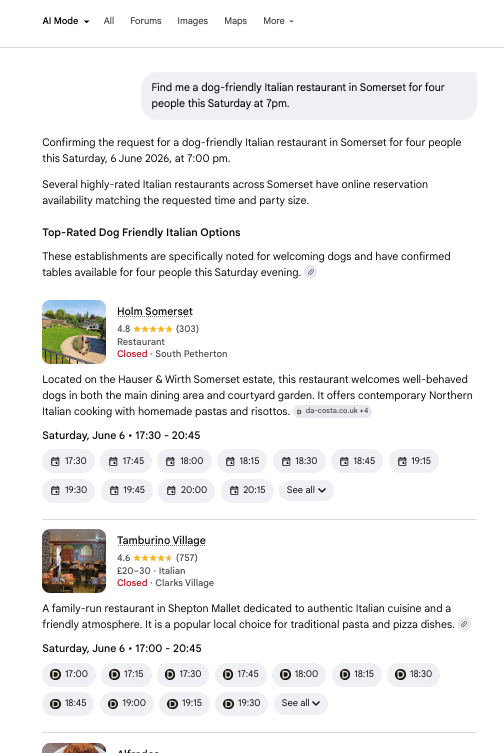
The agentic AI then searches across multiple booking systems, identifies suitable venues with availability, and presents a curated list of options ready to book.
This represents a major shift from traditional search, moving from a user-led journey to an AI-assisted experience that can handle much of the booking process on the user’s behalf.
Historically, traditional restaurant SEO has focused on helping users find your website. As AI-powered search evolves, we believe the goal is expanding beyond rankings alone.
In our view, Generative Engine Optimisation (GEO) is still underpinned by the same foundations as traditional SEO. However, it’s becoming increasingly important to ensure your website, Google Business Profile and wider online presence are aligned with how AI systems discover, understand and recommend businesses.
As a result, restaurants are increasingly competing not only for rankings, but for visibility within AI-generated recommendations.
When a user asks AI Mode to find a restaurant, Google may assess factors such as availability, cuisine, location, reviews, booking integrations and business information before making a recommendation. In many cases, users may never browse a traditional list of search results.
We don’t see AI search replacing good SEO. Instead, we see it as the next evolution of search, making it more important than ever to keep your digital presence accurate, up to date and aligned with the signals AI systems use to evaluate businesses.
Google has confirmed integrations with several major booking and reservation providers, including:
When users search for a restaurant through AI Mode, Google can pull availability data from these partners and present suitable options directly within the AI experience. As Google continues expanding its agentic capabilities, additional booking providers and hospitality technologies will likely be added to the ecosystem.
While the exact ranking factors behind AI Mode remain unknown, the fundamentals closely mirror established SEO and local search best practices:
Booking restaurants is probably just the beginning. Google has hinted that AI Mode will expand to cover other transactions like hotels, travel, and events, showing a clear trend: search engines are turning into action-oriented assistants.
Google’s bigger plan might involve skipping your website entirely. A recent Google patent suggests they could create personalised, AI-powered landing pages on their own platform if a business’s site is poorly optimised (judging by things like conversion rates and content quality). In this scenario, all your products, information, and checkout could exist inside Google’s AI ecosystem, cutting your own website out of the purchase process. Although a patent isn’t a guaranteed product, the message is clear: Google wants to keep users within its system, streamlining the journey from searching to buying instead of pushing them out to external sites.
For hospitality businesses, success is no longer just about ranking. You need to be visible, trusted, and easy to find within the AI systems consumers now use. Crucially, your own digital experience must be high quality—if your site is strong enough, Google will still send users to you rather than trying to handle the whole journey itself.
The restaurants building these strong digital foundations today will be the ones that thrive as agentic search evolves.