
November 18, 2026
AI messaging has reached UK Google Business Profiles, and there are a whole host of features queued up. Here's what's live, what's US-only, and how the EU's DMA changes split the market.

Google Business Profile (formerly Google My Business) is no longer one product rolling out on one timeline. The UK and EU now sit on different tracks, and both trail the US.
Three things matter this quarter:
Below, we cover what’s live, what’s coming, and what to do before it lands.
Google has brought back native messaging on Business Profiles, this time with an AI agent that answers first and hands over to a person when it can’t. In July, Partoo reported it as a US pilot with no European timeline. It has since appeared on UK profiles we manage.
We first saw the Messages tool in the week of 26 October 2026, on hospitality profiles we manage. So far it’s on a handful of our largest hospitality clients, typically the profiles with the highest customer engagement. Some have it on individual locations, while for others it has appeared across a whole brand or chain at once. Our healthcare, ecommerce and other clients don’t have it yet, which suggests Google is starting with high-activity hospitality listings.
None of our clients have switched it on yet, so we haven’t seen the agent handle a live conversation. Google’s own example shows how a conversation could look to customers, from a menu question through to a booking request.
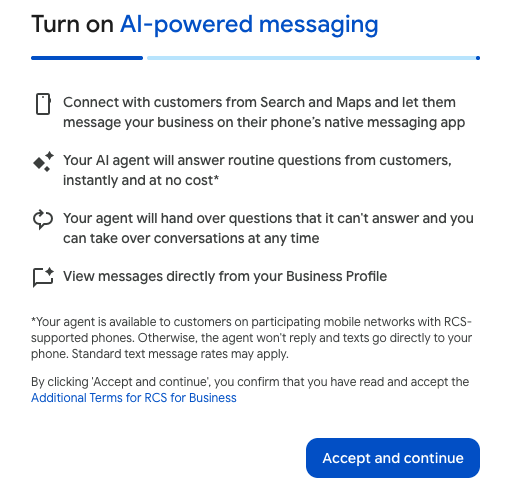
The tool runs on RCS (Rich Communication Services), so customers message from Search and Maps but chat in their phone’s own messaging app. Google’s set-up screen describes four parts:
The dashboard has four tabs:
| Tab | What it does | Live on our UK profiles? |
| Messages | Splits conversations into “Needs your attention” and “Handled by your AI agent” | Yes, on hospitality profiles only |
| Insights | Promised data on what customers ask, what converts and what goes unanswered | Not yet |
| Settings | Welcome message, conversation starters, logo, and a handoff alert toggle | Yes: welcome message, conversation starters, logo and customer handoff |
| Promote | Google Ads that open straight into a chat with the AI agent | Not yet |
Brands can write the welcome message and conversation starters, but there’s no setting for the tone the agent uses in its replies.
This is Google’s third attempt at messaging. It removed the old version in July 2024, then added WhatsApp and SMS buttons in early 2025. The difference now is the agent: a customer asking a question at 10pm on a Sunday gets an answer instead of silence.
That makes your profile data a customer service issue, not only a ranking one. The agent answers from what’s on your listing, so wrong hours or a missing attribute become a wrong answer sent to a customer.
Don’t expect a ranking boost. In Whitespark’s 2026 Local Search Ranking Factors survey, having WhatsApp or SMS enabled ranked 174th of 187 for Map Pack impact but 52nd for conversion. Messaging is a conversion lever.
It’s too early to judge conversions. We’ll update this post once clients have it set up and conversations start coming in.
Since 22 September 2026, Google Business Profiles in the European Economic Area have reported up to 80% fewer Search views. UK, Swiss and US profiles are unaffected. If you manage locations on both sides, stop comparing them on views.
On 23 July 2026, the European Commission fined Google €460 million for favouring its own services in Search and gave it 60 days to comply. Google responded with new result blocks in the EEA: an aggregator unit fed by directories and comparison sites, and a providers block showing business websites. These launched for hotels, flights and products on 8 September, then extended to local business searches on 18 September.
Two separate datasets reach the same conclusion. Partoo’s data across 245,000 EEA businesses shows:
| GBP metric (EEA) | Change since late September 2026 |
| Google Search views | Up to -80% |
| Google Maps views | -6% to -10% |
| Calls | -2% |
| Direction requests | -2% |
| Website clicks | -5% |
GMBapi’s separate study of 15,000 European businesses found a 71% to 74% drop in Search views between 22 and 26 September, with no change in the US, UK or Switzerland.
The actions customers take have barely moved. The most likely explanation is that Google changed how it counts Search impressions in the EEA, not that listings vanished.
The same lesson applies outside the EU. Andrew Shotland (Local SEO Guide) described a 100-location franchise whose local rankings rose 20% to 30% year on year while calls and leads fell 40%. Rank and views no longer map cleanly to revenue anywhere.
UK direction requests are growing faster than anywhere else GMBapi tracks, and much of the AI-driven discovery behind them happens outside Google.
GMBapi’s benchmark, presented by Michel van Luijtelaar at BrightonSEO in October 2026, shows Q2 2026 direction requests up 35.8% year on year in the UK, against 21.1% in the US and 13.1% in the EU. These figures predate the September EEA reporting change.
Part of that growth may come from ChatGPT. When it recommends a business and the user taps directions, a Google Maps link opens and the visit lands in your GBP data as a direction request, with no sign of where it started.
Our own UK hospitality clients show the same trend, with wide variation by location. Comparing May to September 2026 with the same months in 2025, venues in more remote areas saw direction requests rise by around 50%. That rise followed more regular GBP posting and profile optimisation, so not all of it is down to AI. London venues saw rises of 5% to 10% over the same period.
According to research presented by Malte Landwehr (Peec AI) and Andrew Shotland, ChatGPT’s text recommendations draw on editorial lists, delivery apps and review sites. In the UK, Yell dominates almost every category, and Google reviews don’t feature at all.
Whitespark’s 2026 survey points the same way. Three of the top five factors for AI search visibility are citation factors. After a decade of declining interest, UK directories matter again.
Our own quick checks for restaurant clients, five prompts run on 29 October 2026, add some nuance. For broad prompts such as “best places to eat in [area]”, ChatGPT cited Tripadvisor most often, alongside editorial guides such as Harden’s. When we added atmosphere to the prompt, such as “good date night spots”, it started citing Time Out and, more often, the restaurants’ own websites.
For restaurants, Tripadvisor matters more than Yell. And copy on your own site that describes the setting and the occasions you suit gives ChatGPT something to cite.
These features are live or in testing in the US. Most aren’t confirmed for the UK or EU yet, but Google usually follows the same path here, often months later.
| Feature | US status | UK/EU status |
| Gemini editing your GBP | Live | Not available |
| AI map packs | Testing | Not seen on our UK accounts |
| Ask Maps | Live | Not seen on our UK accounts |
| AI Mode bookings via Reserve with Google | Live | Not confirmed; GBP bookings rising |
| LSA charge for unanswered calls | Live | Live in the UK since 1 October 2026 |
In the US, you can ask Gemini to update your GBP, create Posts, draft review replies, analyse Insights data and summarise review themes. It isn’t available in the UK or EU yet.
When it arrives, edit what it writes. Whitespark’s 2026 survey added AI-generated profile text as a new negative factor, ranking it 31st for negative impact and 25th for suspension risk. Let Gemini draft, then rewrite in your own words.
Google is testing AI-generated map packs in several formats. Sterling Sky’s State of Local SEO 2026 research found they surface only 32% as many unique businesses as the traditional 3-pack (5,943 against 18,330 across the same searches), usually showing one or two businesses instead of three. How often they appear depends on who’s measuring: Places Scout data put it at about 8% of keywords in January 2026, and Greg Gifford cited about 13% at BrightonSEO in October. Early examples show big brands with no reviews outranking real local businesses, and links pointing to duplicate profiles.
AI packs don’t include call buttons. Google has also removed the call button from many organic map pack listings on mobile, first spotted in October 2025, while keeping it on paid placements. One study of mobile results found the button missing from around 80% of map packs, with listings under a “Places” label far more likely to keep it than those under “Businesses”. Track AI packs with a tool like Places Scout.
Ask Maps puts a Gemini chat inside Google Maps. People describe a situation (“somewhere quiet for a work lunch near Bank”) instead of typing keywords, and answers lean heavily on Google reviews.
Sources disagree on UK availability. Michel van Luijtelaar’s BrightonSEO deck lists launches in the US and India on 12 March and 150+ countries on 6 August, with the UK and EU unconfirmed. Greg Gifford’s deck describes an international, English-only rollout in August.
When we checked at the end of October 2026, Ask Maps wasn’t available on any of the UK accounts we manage.
What drives visibility is clear either way. Steve Wiideman shared an example of a burger restaurant that rose from page four to first in two days after customers wrote reviews in the form “X offers the best Y in Z”. Reviews that name the dish, the occasion and the area are worth asking for.
Google’s AI Mode can now book or call on the customer’s behalf, using Reserve with Google. Parking operator ParkBee saw 105% more bookings through it than through its old appointment links.
In Whitespark’s survey, bookings through Google partners ranked only 138th for Map Pack impact. Bookings won’t lift your rankings, but in AI Mode they may decide whether you get picked. Missing attributes such as parking, pricing, accessibility and hours can exclude you before ranking starts.
Most of our restaurant clients take bookings through SevenRooms or OpenTable, with Tripleseat and Resy on a few US venues. We’re seeing more bookings come through Google Business Profiles, but it’s hard to tell how many start in AI Mode. OpenTable and Resy are also ChatGPT’s booking partners, so the same integration can serve both. If you take bookings, check your provider is connected to Reserve with Google.
LSAs are now explicitly tied to your GBP. Google now charges for unanswered LSA calls, and this already applies in the UK. If you run LSAs, make sure every call is answered quickly.
Since 1 October 2026, a missed call can be billed as a lead if three conditions are met:
Calls that go to voicemail count too. If callers have to press a key to be routed, the 20-second timer starts when they press it. For restaurants and clinics where the phone isn’t always staffed, either tighten your ad schedule to the hours someone can answer, or route LSA calls to a line that’s always covered.
These changes already apply in the UK and EU. Most have been covered elsewhere, so here’s the short version.
Whether you’re open at the time of the search entered Whitespark’s survey at fifth place. Rankings start slipping about an hour before closing, and closed businesses are displaced by open ones. Set accurate hours, including holiday and seasonal hours, but never list hours you don’t keep.
Predefined GBP services ranked 22nd in Whitespark’s survey, and keywords in services rose 75 places since the last edition. GMBapi saw a 100+ location telecoms brand gain AI visibility almost immediately after updating its services.
To find services you’re missing, Darren Shaw suggests starting a review for a competitor and scrolling to “What services did you get?”. The list shows what that business selected plus what Google suggests. Add anything relevant to your own profile.
A steady flow of new reviews can now outrank a larger but older total. Google has also added the ability to report owner responses, and uses AI to remove reviews that break its guidelines. Affected businesses tend to share three patterns:
The second is a real risk for hospitality, where guests often thank staff by name.
Google remains quick to suspend. One improvement: the 60-minute timer has been removed from the reinstatement workflow. Joy Hawkins’ Ultimate Suspension Playbook is the best reference if it happens to you.
Most of the prep is the same whichever feature arrives first: accurate, complete profile data, reviews beyond Google, and reporting built on actions.
If you want to know how ready your Google Business Profiles are for these changes, or want to discuss an SEO project simply get in touch and our expert SEO and AI Search team will let you know how we can help you get your business in front of the people who matter most to it.