The most important reason to make your website accessible is a simple one: everyone deserves an equal opportunity to use the web. Beyond the ethical side, though, an accessible site is actually better for your business. Select items in the list following to reveal details.
1.3 billion adults globally
16% of the world population; 1 in 4 in the UK alone: include caregivers & family who make purchasing decisions and the disability market touches over 50% of the population.
Spending power
The Purple Pound is £446 billion annually in the UK, global disposable income of this market is estimated at $13 trillion USD.
Lifetime loyalty
Accessible experiences reduce cart abandonment & increase repeat purchase rates.
Market leadership
Early movers gain reputations as inclusive, forward-thinking brands; difficult for competitors to replicate.
AI ready
Accessible code & content, is easier for AI agents to process, interpret, & act upon.
Speech + voice recognition
Alexa, Siri, Google Assistant, & emerging AI agents can only process accessible sites. Non-accessible = invisible to voice search.
SEO multiplier effect
Alt text, semantic HTML, & clear labelling boost search rankings & AI discoverability simultaneously.
Mobile design
Accessible design paved the way for early mobile programming, as it didn’t rely on mouse input.
ADA, EEA, etc.
The regulatory landscape continues to tighten. 8,800 ADA lawsuits filed in 2024, with enforcement remaining consistently above 4,000 cases annually since 2021.
Litigation costs
Even if you win a lawsuit, costs add up quickly. Hefty fines & potential legislation await those who avoid accessibility.
Market-ousting
Non-compliant businesses face discontinued contracts & forced-removal from the market.
Damaged reputation
Lawsuits become public record. Media coverage, social backlash, & customer boycotts multiply financial impact.
Time is money
Fixing accessibility issues after launch often requires rebuilding components, restructuring content, & redoing design work; all very time-consuming.
Roadmap disruption
Retrofitting diverts the roadmap & slows down progress & competitive growth.
Crisis costs
Hours spent resolving accessibility issues, premium rush fees, consultants: all money that could have been saved.
Domino effect
Inaccessible patterns inevitably cascade across design systems and component libraries, creating future issues.
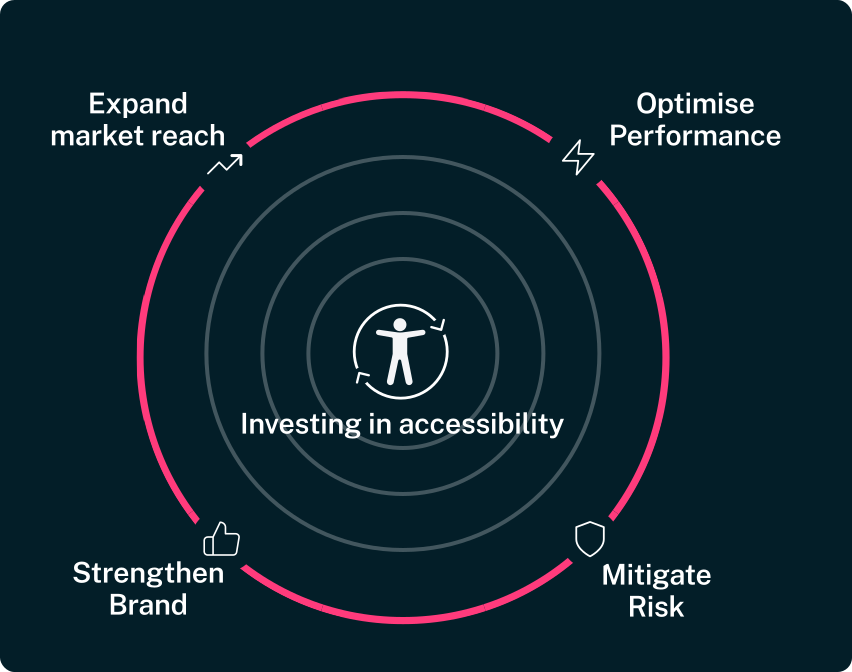
An accessible website offers a better user experience by making content easier to navigate, understand, and interact with for everyone, not just people with disabilities.
Improved usability leads to higher engagement, lower bounce rates, and better performance across devices and platforms. Accessibility best practices also enhance SEO, AI discovery, speed, and overall site efficiency, helping your website reach a wider audience and perform more effectively.
Inclusive design and accessible code creates a positive feedback loop where benefits are interconnected and self-reinforcing. This loop is on-going; accessibility is a strategic investment.

The type of audit you need is based on where you are in your accessibility journey.
How many pages to include in the audit. This depends on your accessibility roadmap.

Navigating the legal side of accessibility can be a bit of a minefield, but we’re here to help you make sense of it. Whether you’re dealing with the European Accessibility Act in the EU, the Equality Act here in the UK, or the shifting legal precedents in the US, the requirements are only getting stricter. We don’t just see this as a compliance exercise; we help you get ahead of these regulations proactively. It’s far more cost-effective to build an inclusive site now than to deal with the fallout of legal action or missed contracts later.

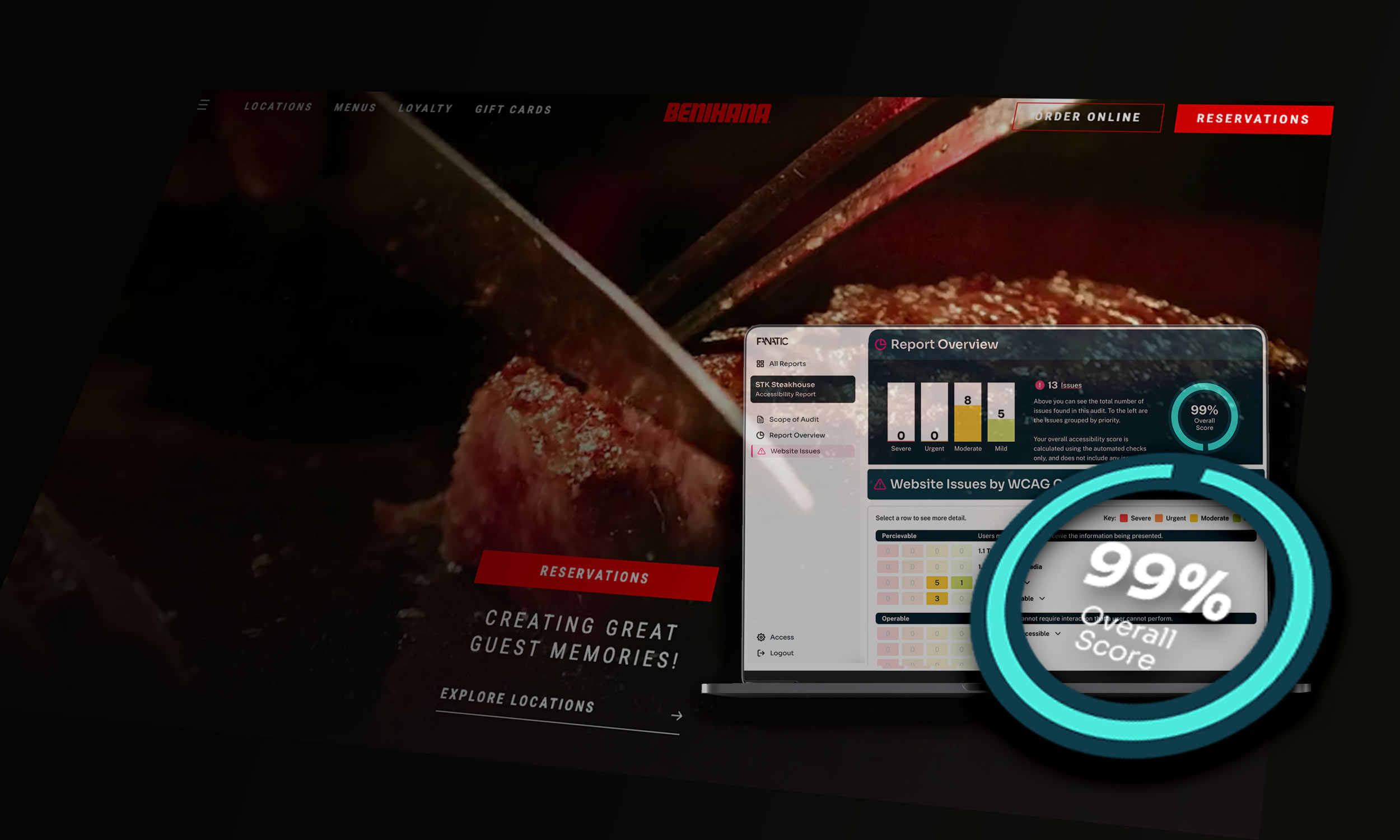
We provide a dedicated client platform designed to give you total visibility over your website’s accessibility journey. Once logged in, you can instantly track your WCAG 2.2 compliance status and see exactly how your site holds up against the latest standards.
The platform goes beyond automated data; it features clear, actionable notes from our auditors to help you understand the nuances of the guidelines. You can monitor progress in real-time: issues currently being fixed by our developers, and any items that might be blocked or awaiting your approval. You will see not only the most severe issues, but the most common issues (helps to identify inaccessible patterns site-wide), as well your website’s accessibility trend across time.
Fanatic has been building websites since 2001, so we’ve seen a lot change in that time. We’ve grown into a team where our accessibility experts are also designers and developers. That matters because it means we don’t just hand you a list of errors and walk away; we actually understand how WCAG standards intersect with your content and SEO, as well as the underlying design and technical structure of your site.
Reach out to discuss accessibility








Website accessibility refers to designing and developing websites so that people with disabilities, including visual, auditory, motor and cognitive impairments can use them effectively. It ensures content, navigation, and functionality are available to everyone. It has been around since the web was invented, so it is not a new idea.
Accessible websites provide a better user experience for all visitors, not just those with disabilities. Incorporating accessibility best practices into your websites also ensures you are compliant with recent legislation, such as the American Disability Act (ADA) in the US, the European Accessibility Act (EAA) in the EU, and the Equality Act 2010 in the UK.
The most globally recognised standard for digital inclusion is the Web Content Accessibility Guidelines (WCAG). While WCAG 2.1 Level AA has been the primary benchmark for several years, organisations are now transitioning to version 2.2 to address evolving user needs.
Interestingly, both the US Americans with Disabilities Act (ADA) and the UK Equality Act 2010 are similar in that they do not explicitly mention WCAG in their text for private businesses; instead, they set a broad legal duty to provide “equal access” and “reasonable adjustments”. In both countries, WCAG has become the “de facto” legal measure used by courts to determine if that duty has been met. This differs from the EU’s EAA, which relies on the EN 301 549 technical standard to define its requirements. Furthermore, ADA Title II in the US and the UK’s Public Sector Bodies Accessibility Regulations now specifically mandate WCAG compliance (v2.1 and v2.2 respectively) for government entities and public sector bodies.
Whilst you can run an automated audit yourself, the most reliable and useful approach is to commission a professional accessibility audit and report. Our team combines technical testing with manual reviews to identify issues and provide actionable recommendations. We currently audit against WCAG 2.2 Level AA unless requested otherwise.
An inaccessible website creates a “digital barrier” that prevents millions of users from engaging with your business. Beyond the legal risk of non-compliance, you face commercial loss: nearly 71% of disabled users will immediately leave a site they find difficult to use. Furthermore, modern AI search agents (like ChatGPT or Google AI) struggle to “read” and recommend poorly structured sites, meaning you risk losing visibility in the next generation of search results.
Accessibility should be reviewed regularly, especially after redesigns or new feature launches. We recommend annual audits at a minimum, with more frequent testing for organisations subject to strict compliance requirements.
Not all accessibility providers work the same way. The key things to look for are a combination of automated and manual testing — automated scans alone only catch around 30% of WCAG violations. You also want a team that understands how accessibility intersects with design, development and SEO, rather than one that hands you a list of errors and leaves you to figure out the rest. Transparency matters too: clear reporting, prioritised recommendations, and visibility over progress throughout the audit. We’d also recommend checking whether they have hands-on remediation capability, or whether they only audit and refer out.
Our accessibility reporting service provides a detailed analysis of your site against WCAG criteria. You’ll receive clear explanations of issues, prioritised recommendations, and practical guidance for your design and development team.
Yes, but in 2026, the benefit extends far beyond traditional search rankings. While accessibility features like alt text and semantic headings remain vital for SEO, they have become even more critical for AI discovery.
Modern AI agents (such as ChatGPT, Gemini, and Claude) “read” and navigate the web using the same technical foundations as screen readers. By adhering to WCAG standards, you aren’t just helping search engines index your pages; you are ensuring that AI models can accurately parse, summarise, and recommend your business in conversational search results. In short: if an AI agent cannot understand your site’s structure, it will not cite you as a trusted source.
Learn how our accessibility service can help you meet compliance, reach a wider audience, and improve performance.
Read our blogs on accessibility and design